  

8/16/2026
WT Staff
 Got water questions? Got water questions? Give us a call at 877-52-WATER (877-529-2837), or email us at info@wtoh.us
August 16, 2026 618 pm EDT
Decades of drought and over-consumption have reduced Colorado River reservoirs to critically low levels, threatening power and water supplies for 40 million people. As nature challenges legal entitlements to fresh water in the USA, experts are calling for a multi-disciplinary management strategy to recover and sustain the ecological functions of the continent's rivers
"Water is life. Water is the giver and sustainer of life. Water is a sacred and spiritual element to the Tribes of the Partnership…. The Partnership will embrace and own the stewardship of the Colorado River and lead from a spiritual mandate to ensure that this sacred water will always be protected, available and sufficient."
– Ten Tribes Partnership Vision Statement
The Upper Basin Rocky Mountains of Wyoming and Colorado are first to capture rainfall and snow melt supplying the Colorado River headwaters. In years of water plenty, the annual snowpack in the mountains started the Upper Basin creeks and tributaries running, adequately providing for seven States and 30 Tribes downstream. Historically and legally, water rights-holders have been entitled to take this water for beneficial use inside the basin, or to divert for beneficial use outside the natural river basin, according to seniority of the taker's claim.
With an average of 20 inches total rainfall in the entire basin each year, the arid Lower basin does not add much more to the total river volume. An estimated 800,000 acre-feet bubble in from springs through the Grand Canyon. By the time the Colorado reaches the US - Mexico border at Yuma, AZ, held back by the Morelos Dam, another 1.5 million acre feet are required to satisfy the 1944 Water Treaty with Mexico. Notwithstanding awful water quality at this point, the BoR water release records from 1971 to 2021 show the deliveries have been made each year. This water does not reach the delta, let alone the outlet in the Sea of Cortez/Gulf of California.
Willingness to share life-sustaining freshwater resources during periods of scarcity is a reflection of human civility. Where clean water is taken as a human right, conservation is rewarded during periods of water scarcity. In times of extended and severe drought, when water storage is depleted, domestic use is prioritized, ensuring essential hydration and hygiene for all. Good neighbors willingly curtail non-essential water use. Where watersheds and waterways are managed for sustainability, storage is adjusted to ease the impact of floods and drought, with minimum volume and flow maintained as a management priority. In this way, continuity of the river's ecological functions is assured as a vital component of the earth's HVAC system.
What we see today in the Colorado River basin is quite another matter. Since 2000, annual rainfall and snowpack in the Upper Basin has averaged 20% below the prior hundred years' precipitation average. Lake Powell and Lake Mead, among the largest reservoirs in the country, have dropped to record low levels this summer. Just 30 to 40 feet of water, respectively, remains above minimum power pool, the point at which power generation fails completely. With so little water remaining in Lake Mead, Hoover Dam's 4 billion kwH powering Nevada, California and Arizona is already falling. After two and a half decades of severe drought, the unchecked water-taking and diversion has brought about a cataclysmic reckoning: forty million Americans may soon be out of power and water.
A century ago, the "wild west" was settling down. Western states passed laws to manage urban and industrial development, including the governance of fresh water. The Colorado River Compact established basic ground rules in 1922, defining Upper and Lower basins from the US portion of a 1450 mile long river, not including the section traversing Mexico. The dividing line separating Upper and Lower basins was placed at Lee's Ferry, AZ, with 2 million people situated upstream in Wyoming, Colorado, Utah and New Mexico. The Lower Basin states were more populous even then, 3.8 million people in Nevada, Arizona and California.
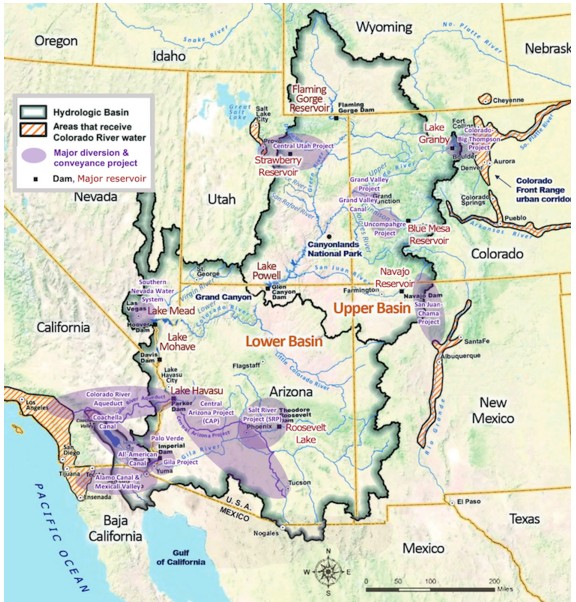
US Bureau of Reclamation - Colorado River Basin with Dams and Diversions
The 1922 Compact was the first of many legal structures comprising the Law of the River, according to US federal Department of the Interior, Bureau of Reclamation (BoR). It is the federal BoR that owns and operates the dams and manages the water releases. The decisions to open the head gates and spillways falls to the US federal government, based on BoR interpretation of applicable laws.
The earliest of the Colorado River laws determined Upper and Lower basin allocations as a fixed annual volume, based on the flow of the day, that inventory taken in a period of water plenty. Fifteen million acre-feet was presumed available in perpetuity, to be shared in equal parts between the Upper and Lower basins. With the benefit of hindsight, it is apparent that dividing a water body on a presumption of a consistent annual flow volume was not the best sustainable management plan.
The Upper and Lower basins determine how their respective 7.5 million acre-feet are divided among their stakeholder States and Tribes. Water takers include cities, towns and settlements for domestic potable water, private enterprise and industrial users, excluding agriculture use approximately 18% of the water, according to Environment and Energy Study Institute (EESI). Agricultural irrigation accounts for 52%, the single largest use of Colorado River water. Nature uses 19% for trees and natural vegetation, with evaporation claiming 11%, maintaining the hydrological cycle.
Upper v Lower: interpretations and priorities
Separate agreements define how the Colorado River allocations are utilized by the states within each basin. Differences are notable: the Upper Basin divides water between states by percentages of available supply; the Lower Basin maintains allocations by fixed volume acre-feet, regardless of available supply. In the Upper Basin, evaporation loss (approximately 11%) reduces deliveries to the users; in the Lower basin, the states receive their allotted volume with no adjustment for evaporation loss. In the Upper Basin, the 7.5 million acre-feet has not been fully utilized. Unused surplus held in Lake Powell does not remain in the bank for future use by the Upper Basin states, rather the US BoR releases the Upper Basin's unused allocation downstream, where the Lower Basin has become accustomed to completely using it up.
The Upper Colorado River Commissioner allocates annual water deliveries between Wyoming, Colorado, Utah, New Mexico and Tribal water rights-holders, based on the water available each year. Each spring, Upper Basin water rights holders are informed of their deliveries for the year. EESI reported the Ute Mountain Tribe of Colorado took a 90% cut in 2021 water deliveries, forcing a mass layoff of staff and fallowing of 6000 acres of farm land.
In the Upper Basin, the 11% lost to the natural process of evaporation reduces water deliveries deemed available to the rights-holders. In the Lower Basin, water deliveries have been maintained on the fixed schedule determined 100 years ago. The fixed volume delivery schedule is received as an entitlement to the first taker, protected by law as a matter of private property. The Lower Basin's senior water takers have maintained their full entitlements by receiving the Upper Basin's unused portion from the BoR, and in recent years, drawing down the water stored in the reservoirs.
Drought Contingency Plans (DCPs) have been discussed in the Lower Basin since at least 2019. The DCP's are voluntary arrangements to reduce water use, triggered by the level in the storage reservoirs. That level has been reached this summer. Documents exchanged between the major Lower Basin water users in 2019 show the senior appropriations, seven irrigation districts of the south-central valleys offering voluntary conservation measures of 3%. The subordinate takers in the Lower Basin include Metropolitan Water District serving Los Angeles and southern California negotiating with the farmers on behalf of 20 million people that need potable water.
The principle that flies in the face of water conservation
The US BofR details the Law of the River, including this note:
In 1979, the Supreme Court issued a Supplemental Decree which addressed present perfected rights referred to in the Colorado River Compact and in the Boulder Canyon Project Act. These rights are entitlements essentially established under state law, and have priority over later contract entitlements.
Two realms collide: the Law of the River's fixed volume definition and water use as entitlement over against the Law of Nature, where annual water deliveries are far from fixed.
Prior Appropriation law holds that senior water takers (the agricultural irrigation districts in south central CA) cannot be forced to reduce their allotment of Colorado River water, regardless of the severity of drought. The senior water takers are entitled to receive their full allotment before subordinate water takers (including cities in CA and AZ) can take water at all. There is no provision for higher priority of beneficial use here. Interesting to note, the agricultural irrigation district at Yuma, AZ grows a significant portion of the winter vegetables for the entire country. Water for growing human food is not prioritized. The senior water takers can go on producing feed for racing camels under the current water laws, before AZ farmers can grow salad for Americans.
Use it or lose it
With Upper Basin annual water use shortages averaging 1.3 million acre-feet for twenty years, one might expect to find Lake Powell at full pool, 24.322 million acre-feet maintaining full capacity power generation at Glen Canyon Dam. Alas, not the case. Lake Powell is down almost four feet in the last month, currently 21.7 % full, 30.25 ft above power pool and 150 feet above dead pool. The Bureau of Reclamation owns the dam, employs the operators at the head gates. Releases from Lake Powell are made according to BoR management, which may be influenced by the political powers downstream. Consider, Colorado has 8 representatives in Congress, California has 54.
Prior Appropriation law is essentially a deterrent to conservative management of water. The law favors the senior taker, not the particular beneficial use. For those senior takers, farmers in California's south-central irrigation districts, they are incentivized to grow the most valuable crop, and sell to the highest bidder. The right of the senior takers in effect, supports Colorado River water being used inefficiently. As it turns out, a lot of the irrigated acres are in alfalfa, a high water demand crop not naturally suited for such arid conditions. A significant portion of the first priority water use supports production of feed crops for animals, and a good portion of that is exported to the Middle East and China.
US water laws promote senior takers using their entire allocation each year, whether they need it or not. After all, water is valuable, it will be fully utilized wastefully or inefficiently, if it cannot be sold to a taker with a subordinate claim. In this scenario, there is no incentive for farmers to improve their water use efficiency. There is no incentive to improve soil health to infiltrate and store more moisture, reducing the water volume needed to maintain the same output of crops, as are done in the dry farming regions.
Better agricultural management practices have been tried and tested in regions without irrigation. These water use efficiency techniques include selection of drought tolerant crops, seeding of multi-species forage, companion crops and cover crops improves soil health and conserves moisture. The application of mulch in row crops can reduce moisture loss from the soil. The adoption of efficient irrigation works and smart sensor technology reduces water usage per unit of mass produced. In spite of all these options to reduce waste of water, the law still supports excess use of scarce water resources.
This legal framework of Prior Appropriation determines clean water as entitlement by seniority, over against clean water as a human right. Managing out of this dire water shortage requires some different thinking than the management that got us here.
Climate considerations to water sufficiency
The law may define the priority for water deliveries, however, nature ultimately determines the supply. As the actual flow rate has been less than the annual allocation for many years in a row, closer to 12 million acre-feet per year, management is finally catching up with reality. Regardless of the legal framework and what may be supported in court,
all Colorado River water takers understand cooperation is necessary to ensure the sustainability of the power and water supply. No matter who has the right to fill their bucket first, it does no good for senior takers to force the reservoirs to minimum power pool, cutting off the power grid, or dropping water levels to dead pool, the point at which water no longer discharges downstream of the dams. As of now. Lake Mead is 145.5 feet above dead pool, the end of the line for the lower basin.
The last change of administration in the White House brought steep staffing and budgetary cuts to the agencies responsible for Colorado River Management with the current arrangement expired. Lower Basin States of California, Arizona and Nevada have proposed cuts to their water use, 18 to 20%. The Upper basins has not officially responded. In any case, the federal government has the last word on Colorado River management. With the storage reservoirs all but used up, annual consumption cuts must follow what nature delivers. The US BoR issued a decree in late July that will be enforced by the end of this year unless the Upper and Lower basins reach a better solution. Based on the adjusted annual flow, the BoR expects a 3 million acre-foot cut from the current consumption.
Analysts from both sides of the basin, academics and national think-tanks have contributed commentary around this issue. Some say the cuts should be taken from both sides of the basin. Former lead negotiator for the Colorado River Upper Basin states in 2000, Greg Walcher explains how the water resource inevitably ends up going to those with the most representation in US Congress, regardless of any real-time supply constraints. For the last ten years, the State of Colorado has adjusted to the conditions by voluntarily cutting 1 million acre-feet per year below allocation for the last ten years. During this same window, California continued to take its full annual allocation of 4.4 million acre-feet, an absolute value established in the Colorado River Compact of 1922. Not only has California declined to trim water draws in light of 20% less supply through the system, the most populous state continues to take the surplus water to which it is accustomed, about 11 million acre-feet above allocation in the last decade. Walcher said: "I don't think it's ignorance. I don't even think it's arrogance. I understand the entitlement mentality." This is a state with 54 Congressional Members compared to Colorado's 8 members, and Wyoming's one member. The federal BoR lets water go from storage to satisfy California, no matter what the water storage situation has been. California was asked to quantify their water rights going forward, and this is not an easy task.
WT notes, the largest Colorado River water user, California, does not treat their own water resources in an unsustainable manner. Rivers originating in northern California's Sierra Nevadas are managed sustainably by California Water Boards. Absolute deference appears to fall on the remote USGS flow sensors and established minimum water levels. The Scott and Shasta Rivers, as an example, are carefully managed with notifications to water users demanding an immediate end of withdrawals the moment water levels fall below the minimum threshold for a given month. Once that stop notice is given, all water users are treated as one, there are no draws allowed. Period. Why is it different in the Colorado River case?
Allocation of water as a human right
When water management is approached from the supply side, with allocations ensuring maintenance of the river's elemental functions, supporting the continental hydrological system, we see a different decision making matrix. Sustainable water management considers climate data, trends in the mean annual flow, changes in storage levels, precipitation and evapo-transpiration trends through the entire basin, from headwaters to deltas and outlets. When water management is constrained by the natural order and the water levels required to maintain a functioning continental hydrologic cycle, the water rights holders are the ones to adjust, mitigate and adapt to the changing conditions.
Human populations have certainly expanded in the west. The Upper Basin today supports 12.2 million people, the Lower Basin has topped 50 million. When water is taken as a human right for all, rather than private property for the first taker, the management decisions will change. When the total volume available for extraction prioritizes domestic use before industrial use, and domestic food production ahead of production for export, we will see the Law of Nature take effect. Water rights holders, including every person, no matter how small, will be encouraged to share. Tribes, municipalities and industry will all be inclined toward water conservation, elimination of waste, greater care around contaminants and pollution. When water allocations are based on available clean and fresh supply, everyone will adjust their water use to fit.
See WT exclusive article with Dr. Peter Leavitt, "The power of a continental approach to source water protection", here.
See EPA advises rural householders to seek water quality assurances directly from data center developers. For all the water-positive talk from Big Tech companies, the public is pushing back for the right to clean water in America, here.
|
|
|
|

